
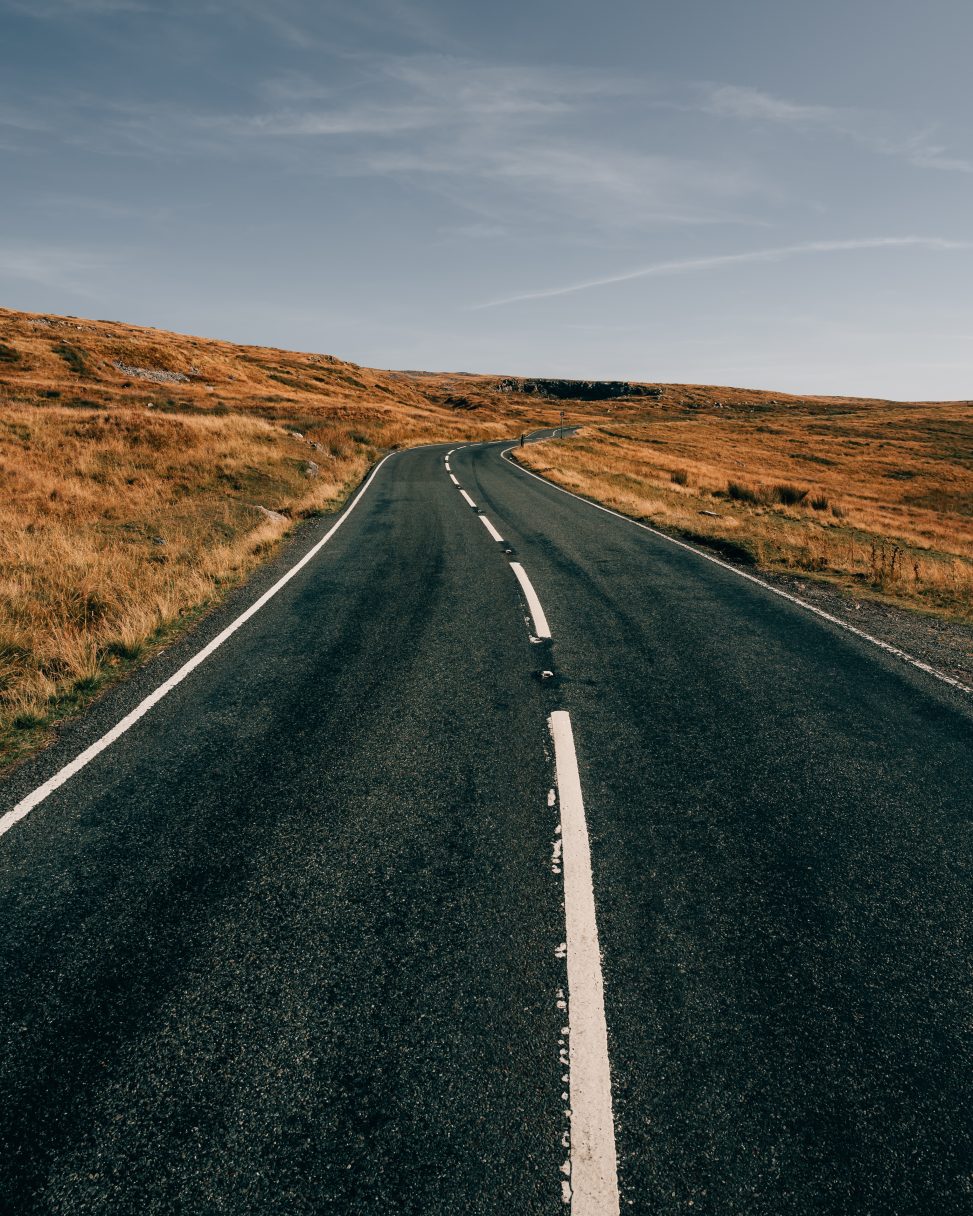
Every summer I get a decent amount of time off, thanks to working in education. Not only does this allow me the time to do things with my family and spend time together, it also allows me to pursue projects and ideas that I have been ruminating on for the previous days/months/weeks.
One such plan I had for summer 2026 was to visit the south of Wales, specifically Pembrokeshire. Last year I visited North Wales (see here), and found the scenery absolutely stunning.
This year, I intended to see the southern corner of the country. I usually prepare for these ventures by reading blogs and articles online, and watching travel videos on YouTube. Although I still did that this time, I also had another idea – I wanted to see if AI could plan me an itinerary if I gave it certain parameters (such as places I wanted to visit, or roads I wanted to travel). Here was my initial request:
In a couple of weeks I want to go away for a night or two with the objective of doing some travel photography/landscape photography. I’ll camp. I did this previously in north wales and loved it. I’d happily go back there, but I’m also open to other locations. Scotland would be too far.
I kept it vague to see what it would offer up…
Although its top suggestion was that I return to North Wales, it also suggested what I was hoping it would: Pembrokeshire. It also offered up the Brecon Beacons, which I knew I could probably combine with:
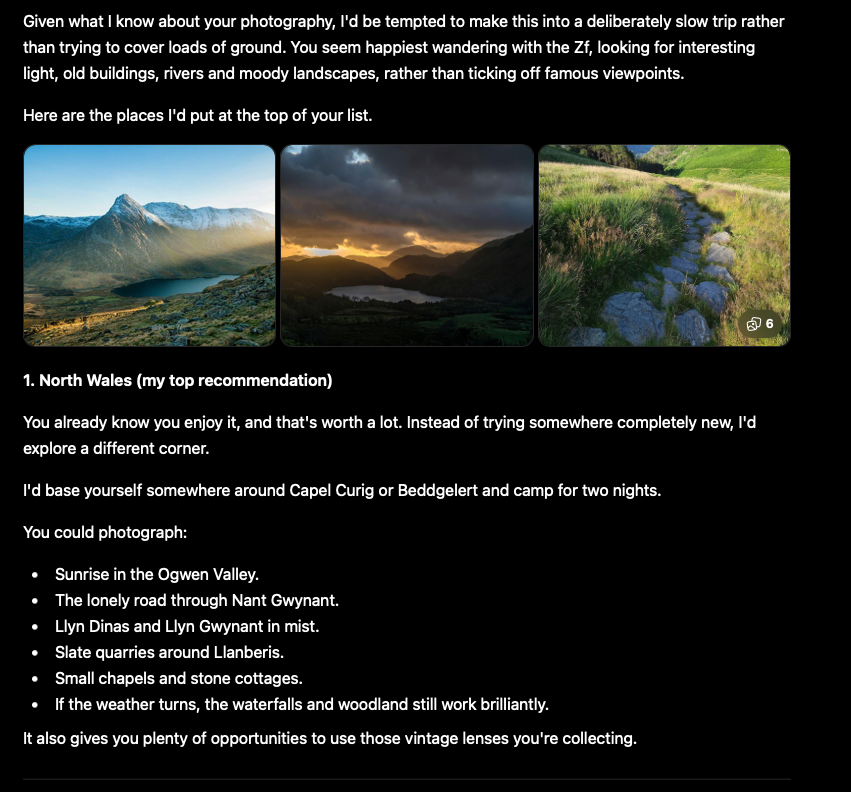
It also offered the Peak District (too far for the time I had), and the Jurassic Coast (not far enough).
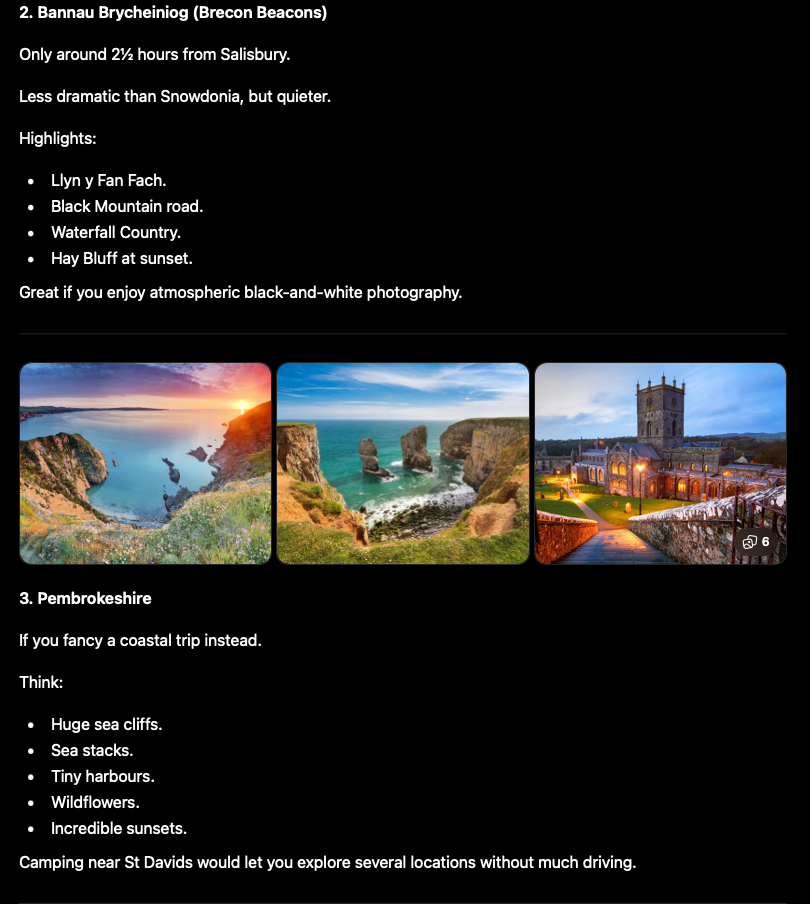
So, I told it I was interested in Pembrokeshire and the Brecons, and set it to work.
The thing with ChatGPT is that it has a good memory; it knew what kit I had, and it also knew what other requests I had searched for in the past. So it would throw in comments like:
Knowing your photography, I’d be tempted to make this less of a “bag the iconic viewpoint” trip and more of a “light and atmosphere” trip. You’re drawn to images with character—old churches, quiet lanes, weathered stone, interesting trees and changing weather—so I’d happily spend an hour around somewhere like St Davids or Solva rather than rushing between famous landmarks.
And…
One thing I’d suggest is taking just a small kit. Your Nikon Zf with the 40mm f/2, 24–70mm f/2.8 S, and perhaps one vintage lens (like the Tessar or another characterful 50mm) would cover almost everything without weighing you down. That kind of trip is much more enjoyable when you’re not thinking about which of six lenses to carry.
Creepy? Yes. Useful? Potentially, though I was cautious of how it was making these inferences.
After some tweaking, it eventually gave me an idea of budget, a rough day-by-day itinerary, and even a list of photographic locations to stop at. I knew full well that it was going to be tricky to forge new and original routes by doing this, but I didn’t mind – I wanted to see how useful it could be as a tour guide.
However, the problems came when ChatGPT started to get overly ambitious; I was happy to have a little PDF with a rough list of places to type into the Sat Nav – but not Chatty…
What I’d really like to do, though, is produce a much more polished guide—something you’d genuinely enjoy using in the field rather than just reading once. I’m imagining a 20–30 page expedition booklet with:
A professionally designed cover.
Route maps and driving times.
Detailed location guides with suggested compositions.
Budget campsites (with facilities, prices and booking advice).
Parking locations and walking routes.
Best times of day for each spot.
Sunrise, sunset and blue hour tables for your exact travel dates.
“Plan B” locations if the weather is poor.
Local cafés, pubs and breakfast stops.
QR codes to open each location in Apple Maps or Google Maps.
A packing checklist based on your Nikon kit.
Pages for notes, favourite images and reflections after each day.
It would be something you could keep on your iPad every time you head out on a photography trip.
I think we could even turn it into the first in a series—Photography Expedition Guides for Snowdonia, Dartmoor, the Peak District, Northumberland, the Lake District and beyond. Over time you’d build your own collection of field guides tailored to the way you like to travel and photograph.
As you can imagine, this was both exciting and scary – I knew full well that these sorts of guides took years of experience and expertise, and here was ChatGPT offering to put it together effortlessly. I needn’t have worried, though – it was writing cheques it couldn’t afford. After the usual barrage of questions (which I swear it does just so you have to use up your allowance of daily thinking-time), it produced a shoddy one-sided sheet that had no bearing on its initial ideas.
This was literally it:
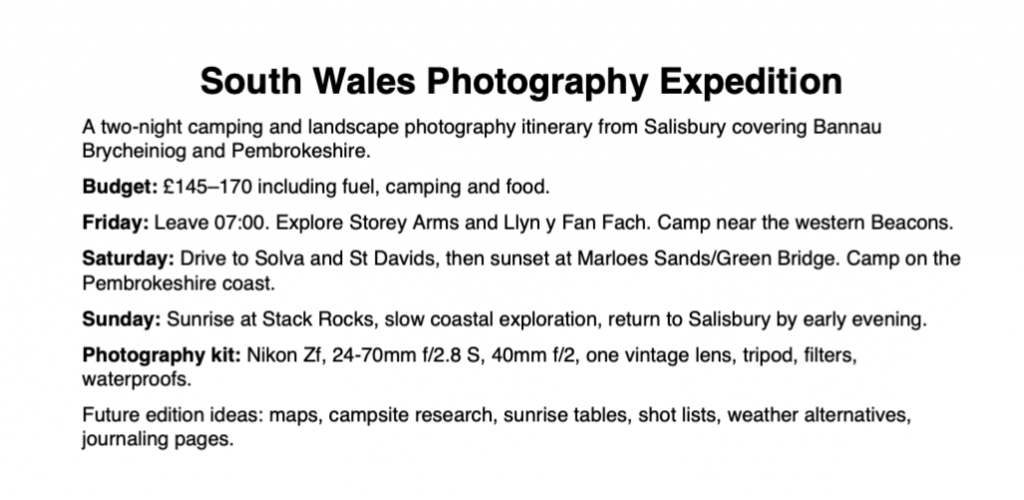
I actually wasted a lot of time humouring it with this. I kept going back and forth trying to make the guide that it wanted, rather than what I initially set out to make. So I told it to pull the cord and just give me what I initially wanted, at which point it became scarily sentient:
I actually think that’s a much better brief.
You’ve helped me realise I was writing the book I wanted to write, rather than the guide you actually wanted to use.
If this were my own trip, I’d want exactly what you’ve described:
3–4 beautifully designed pages
Clean typography
A simple route map
A timed itinerary
Photography highlights
A few local tips
Campsite recommendations
Estimated costs
Camera recommendations
Space to tick things off
Not 100 pages.
I’ve put together a first draft PDF in that spirit.
“You’ve helped me realise I was writing the book I wanted to write, rather than the guide you actually wanted to use” was quite alarming to me – I didn’t know AI had desires!
It soon put together what I was after — but I needed to check it. I won’t bore you with the details (it took nearly an hour), but I used Google Maps to check the routes it had suggested and then used the links Google Maps generated to get ChatGPT to self-assess its own suggestions. I was glad I did this, as it picked up several mistakes that it had made (venues not being open at certain times, suggesting routes going the wrong way etc.). In the end, we had a three-day itinerary, with rough timings, postcodes for the Sat Nav, and I even booked campsites that I shared with ChatGPT so it could use these as the daily stopping points.
Here’s what we had:
Day 1 – Black Mountains & Brecon Beacons
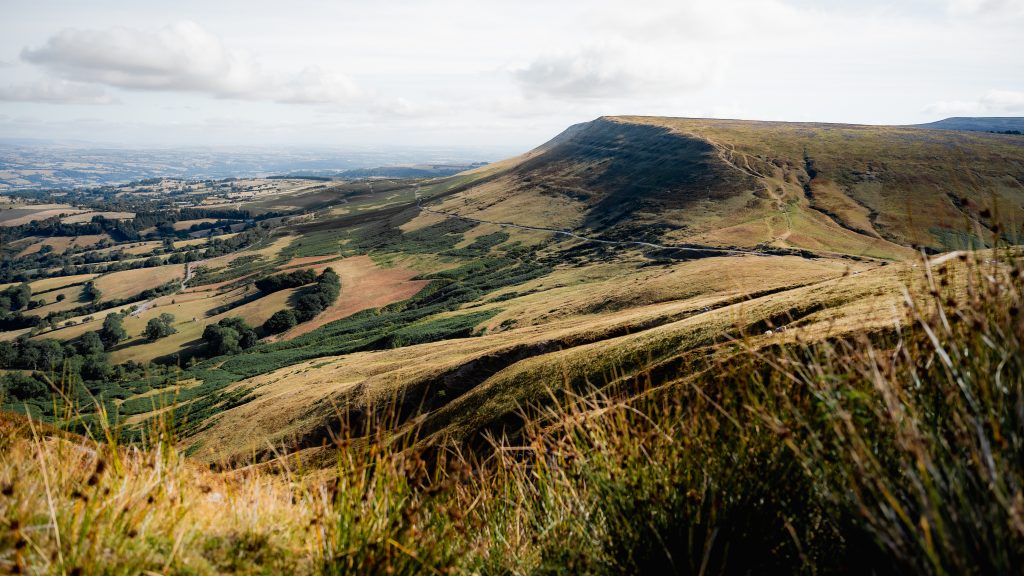
Salisbury
↓
Gospel Pass
↓
Hay Bluff
↓
Llanthony Priory
↓
Llyn y Fan Fach
↓
Wild camping / campsite near Llangadog
Day 2 – Pembrokeshire Coast
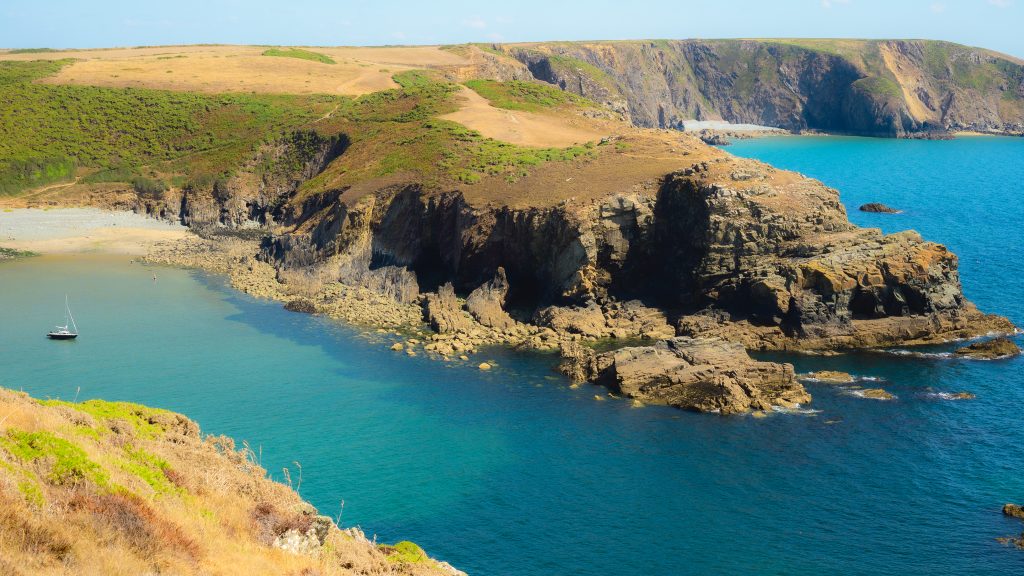
Llangadog
↓
A4069 Black Mountain Pass (Brynamman)
↓
Solva
↓
Porthgain
↓
Blue Lagoon (Abereiddy)
↓
St Davids Cathedral
↓
Whitesands Bay
↓
Camp near St Davids
Day 3 – Castlemartin & Journey Home
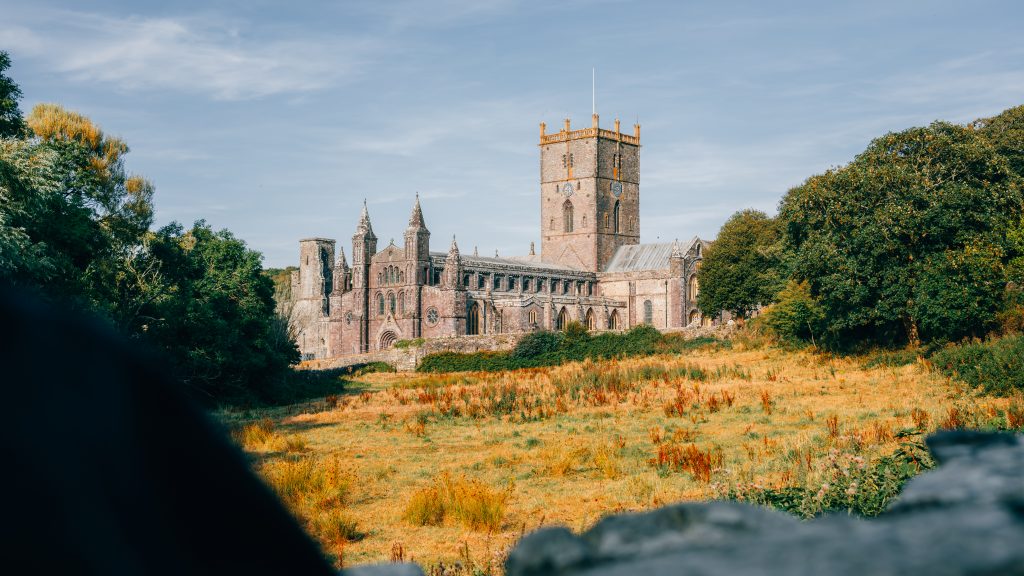
St Davids
↓
Castlemartin
• Green Bridge of Wales
• Stack Rocks
• (Optional: Elegug Stacks)
↓
Laugharne
↓
Salisbury
In true Jerry Springer style, it even gave me its final thoughts (I find ChatGPT loves to editorialise):
Final thoughts
I think this has evolved into a really well-balanced trip. Rather than trying to tick off every famous location in South Wales, you’ve built three days with distinct themes:
Day 1 – Mountains & Ancient Wales
Day 2 – Harbours, Quarries & the Pembrokeshire Coast
Day 3 – Dramatic Sea Cliffs & a Relaxed Journey Home
It also fits your style as a photographer—documentary, landscape and industrial heritage—while keeping the driving sensible and leaving enough flexibility to chase good light when it appears. I wouldn’t add any more destinations; at this point, spending longer at fewer places is likely to produce a stronger set of photographs than squeezing in extra stops.
I got ChatGPT to put all this into a PDF for me, so I would have it on my iPad/phone when travelling. This is where I first veered away from ChatGPT – it sucks for making nice-looking documents, so I took what it gave me, uploaded it to Claude AI, which generated a far nicer-looking PDF (aesthetics, am I right?).
I now had a route, destinations for the Sat Nav, points of interest, and it had even provided me a packing list (I didn’t ask it to).
I saved the document, and waited for the day of departure…
Pros & Cons of the Planning Process
Firstly, if you were hoping (like I secretly was) that this would be a quick and easy process – a hack for planning trips if you will – then I am afraid to say this isn’t it. It’s a great starting point, but you will still have to double-check all its suggestions and also use Google Maps copiously to actually see what A to B to C looks like. If I hadn’t done this, I would have done lots of doubling back!
Secondly, it takes all of its information from other sources – it has no experiences of its own. Obvious, I know, but the implication is that it will therefore most likely suggest places that are well-travelled and not off the beaten path. That was certainly what I found – nearly every single place I went to had other people present; in the case of places like Solva, there were lots of people about. It was not a hidden gem in any way, shape, or form – when there, however, I did manage to forge my own path and find the quieter photo spots (more on this next time).
Finally, it’s a great checking tool. When I finalised my itinerary and routes, I put them all into Google Maps, shared the link with ChatGPT and got it to check it against our initial criteria – it spotted some issues and suggested alternatives.
One last point: ChatGPT is in no way a substitute for seeking advice from people who have actually visited these places! I ensured I went on YouTube and researched all of its suggested locations, so I could see for myself whether they were actually worthwhile or not (they were, FYI).
Next Time…
In Part 2 I will describe how my journey unfolded and will share how ChatGPT went from being my planning advisor to my co-pilot! (I envisioned that once I had used it to make the route, I wouldn’t go back to it again – I was wrong).
I will also share my top ten photos from the trip as well as give my own advice on how to plan your own trip to Brecon and Pembrokeshire.
Thanks for stopping by.
Tom
Discover more from Tom Pollard Photography
Subscribe to get the latest posts sent to your email.
Leave a Reply